"I have useful IT experience, but I don't know how to turn it into Technical Writing."
Parts of it probably already count. The call shows you which parts a Technical Writer hiring manager would notice, and how to describe them.
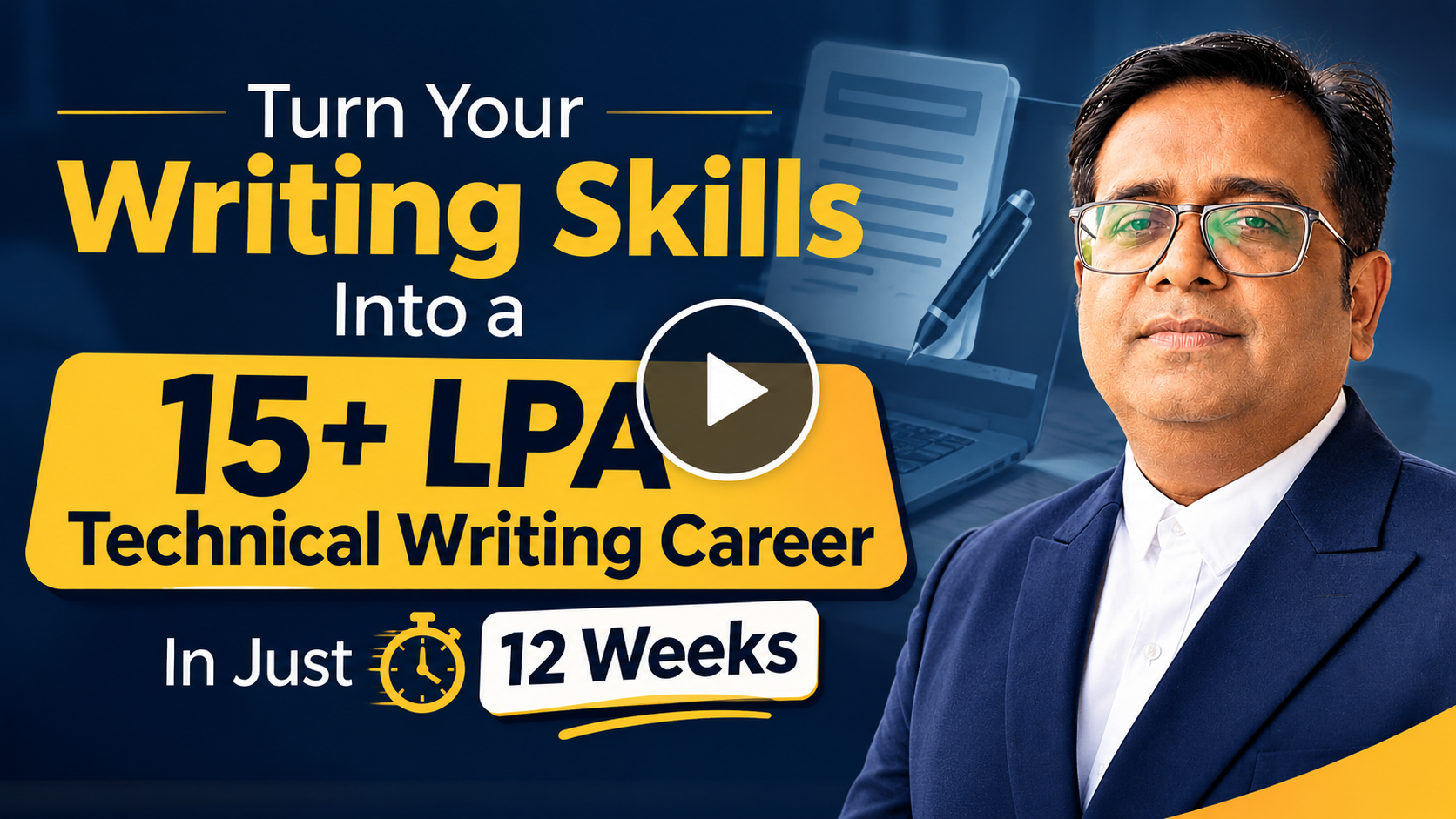
In this 1:1 call, Rahul Karn reviews your writing experience, portfolio and resume to identify your gaps, assess your readiness and show you exactly what to do next.
Limited slots: only 11 available
You have years of writing behind you, in content, copywriting or publishing. Maybe it came from IT, support, research or teaching.
Technical Writer openings keep showing up. You have taken a course, read about DITA and MadCap Flare, and sent your resume to roles that looked like a fit.
Most of those applications got no reply, because the resume reads like every other general writing resume in the pile.
Late at night you search "Technical Writing portfolio" and "Technical Writer interview questions", and you close the tabs with more questions than you started with.
Friends say "just apply anyway." Nobody can tell you what a software company looks for in someone coming from your background.
Somewhere along the way a thought settled in: "I have the experience, but I can't prove it for this role."
If that sounds like you, keep reading.
You have tried:
Each one adds a piece. Nobody has checked how the pieces fit together.
A move into Software Technical Writing depends on five connected things: the experience you already have, how well you understand software, the samples you can show, how your resume and LinkedIn read, and the story you tell in an interview. A weak link in one makes the rest harder to believe.
Think of a translator who does excellent work and hands it in using the wrong language. The skill is real, and the reader cannot see it.
Your writing experience is in the same position. It has value, and it has not yet been turned into something a software employer reads as documentation work.
You have been solving a connected problem one piece at a time.
That is what this call is for.
Limited slots: only 11 available
"I have useful IT experience, but I don't know how to turn it into Technical Writing."
Parts of it probably already count. The call shows you which parts a Technical Writer hiring manager would notice, and how to describe them.
"I'll have to start again from the bottom."
Employers hiring Technical Writers look at what you can show and how clearly you explain things. Your years of work still count when they are presented in that form.
"I'm not technical enough."
Rahul started with no technical background and no IT experience. The role needs you to understand software well enough to explain it to a user, and the call shows you how much that takes.
"I need a portfolio, but I have no software-company work to put in it."
A portfolio is made of documents you write. In the call, you and Rahul decide which samples to create first.
"Another certificate will fix this."
Employers ask to see work. The call shows you where you stand today. It does not replace training, and it does not promise a job.
This is a private 1-hour, one-on-one call, exclusively for you.
Our team goes through your resume and work history. Process notes, manuals, reports, support replies and similar work can count as documentation experience, and mark which of yours do.
You'll see which parts of your past work help you and which gap an employer would notice first.
Software concepts, APIs and how developers work all show up in Technical Writer interviews. Rahul checks where you stand on each.
You'll know what to learn first and what can wait.
Employers ask to see work. Rahul looks at any samples you already have and decides which documents you should write first.
You'll leave knowing what to create and what each sample needs to show.
Your resume, your LinkedIn headline and the way you explain your move in an interview all get a review.
You'll have a clear way to say why your writing background fits a software team.
Limited slots: only 11 available
You have spent time and money on courses and certificates. This is the first time someone looks at all of it together, and you leave knowing where you stand.

After a serious accident left him bedridden for nearly three years, Rahul had to rebuild his career from scratch, with no IT experience or technical background.
He independently explored Technical Writing, understood what software companies expected, and landed his first role at i-flex (now part of Oracle Financial Services). His 20+ years of industry experience eventually led him to create the InfoDev Insider Method to help other writers make this career transition.
Coming from an aerospace engineering background, transitioning into software technical writing seemed challenging. With the right guidance, continuous learning, and persistence, I discovered my passion for technical writing and built a new career path.
I transitioned from software development to technical writing and built over 14 years of experience in the field. Today, I lead documentation initiatives, mentor aspiring technical writers, and help others build successful careers in this profession.
Testimonials are self-reported.
Limited slots: only 11 available
It starts with one call.
Bring your resume and any samples you have. If you have no samples yet, the call still goes ahead and Step 3 covers what to create first.
Yes. Rahul started the same way, and Step 2 shows you how much software knowledge the role needs.
No to both. It shows you where you stand and what to do next.
Yes. Bring the question and it becomes part of the call.
You carry on as you have been. More courses, more applications with the same resume, and the same silence from employers. You are still the one trying to connect every piece alone. What will be different a year from now?
You book one call. We look at your complete picture and tell you what needs attention first.
Limited slots: only 11 available